Thursday, March 14, 2019

Snapshots of Life


This is a photo of Jubilee House, the presidential palace in Ghana.  It is the equivalent of the White House in the U.S.A.


There are some really nice homes in Ghana as can be seen here.  Sorry that the pictures were taken at a distance.  This was a taken a little ways out of Accra itself, in one of the surrounding communities.  As can be seen the growth is a little more natural on roadsides out in such areas, and can come right up to the homes - though this is the exception, not the rule.


Another example of a large home.  This is also not in central Accra, as can be seen by the dirt road because in the main city the vast majority of roads are paved.  In more outlying areas dirt roads are not an unusual sight.  In the central city goats can be seen now and then.  In outlying areas such as this, they are common.  Notice the high masonry walls topped with electrical wire.  Very common surrounding compounds that contain nicer homes or apartments.  Sometimes there is concertina wire instead of electrical.  This is a preventative measure to keep honest people honest.


One of the reasons that it is a good idea to encourage honesty in the ways previously described is because of the contrast between the haves and have nots.  There is a lot of housing that looks like this.  These are metal storage/transportation containers converted into homes.


I did not get a good look at these, but I believe they are other storage container homes, these sitting next to piles of rubbish.  In my experience, such piles of refuse are not often this close to homes, but it does happen.
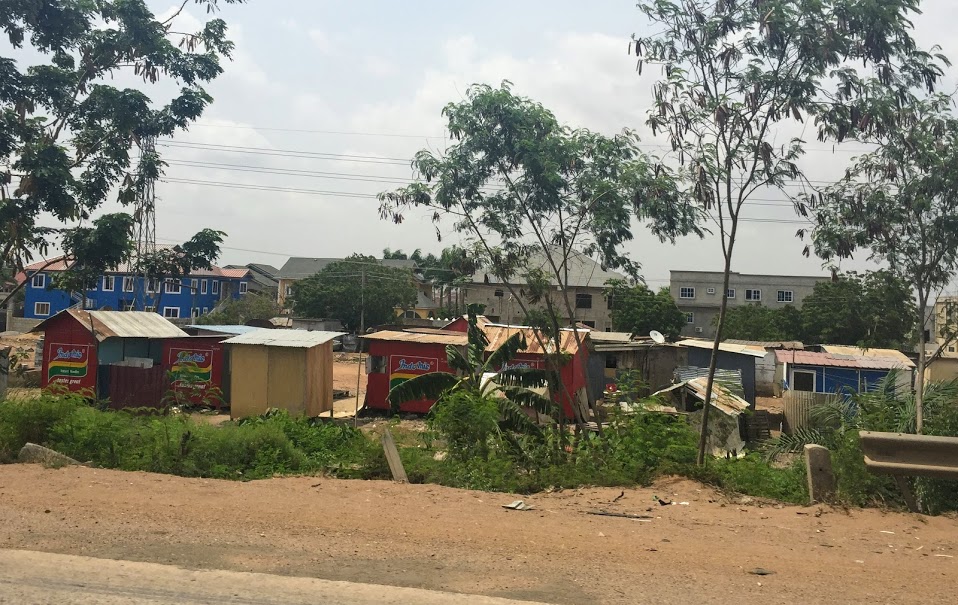

This photo shows the contrast between the nicer homes/buildings (in the background) and the storage container homes (foreground).  They are often side by side, rather than kept apart by zoning ordinances as I am used to in the states where I have lived.  You might also find the flora interesting, as well as its proximity to the homes.


This is a farm located between the central city and the closely linked but smaller cities that surround it.  On the left hand side of the picture is a structure that is either the home of the farmer or perhaps a temporary shelter for when he is at work in the fields.  Corn seemed to be the primary, but not only, crop.  These farms in this area were not separated by fences so it was hard to see where each one began and ended.  In my conversations with a friend who used to be a farmer, I got the impression that farms tend to be small.  He grew up on a 5 acre farm.  When I see the work going on in the fields it is done by hand.  For example, the farmer is often using a hoe to work his fields.  That is hard work anyway, but especially so when it is 88 degrees and 75% humidity!


Again, the contrast side by side.  On the right are large and quite nice houses.  On the left is a large section of shanty homes.  I should note that the nice homes are middle class, not the wealthy.


In previous pictures street hawkers have been shown.  This is a little different because the selling was going on on the sidewalk.  This is a sort of open air shoe store.  The shoes were simply spread out on the pavement and people came by to pick out what they wanted, rather than the seller walking between cars at the light.


There are many areas in the cities where roads are lined with booths where goods of all sorts are sold.  This is just one example.


We were fascinated by this scene.  The same parking lot held ambulances (towards he back fence) and hearses (on the left).  I am not sure if they are planning ahead or what.  Be prepared in case the ambulance does not arrive in time, perhaps?


A close up of some of the shanty homes inhabited by the poor.


A closer view of container homes.  Notice the clothes line in the foreground.


Another close up of a shanty home.  In this case, the native growth grows right up to the building.

We both find ourselves tremendously busy.  Sister Emfield working with the missionaries, and I working with local members.

Many of the people here have so little, but they are friendly and happy.  They love to sing the hymns, and to laugh, and even though the drivers are extremely aggressive (and that is an understatement!), they don't get mad at one another, and it is quite common for these very aggressive drivers to, out of the blue, make way to let someone into traffic.

For those who are concerned, we remain healthy.  We were told that there was little chance that we could avoid getting malaria in this tropical country, but that if we took our anti-malaria medication we would probably never know that we had had it.  The meds would kill it before we had any symptoms.  We pray that that will prove true.

Elder Emfield

Tuesday, March 12, 2019

Some Observations


Some further observations today.

When Ghana achieved its independence in 1957 the population was 41% Christian.  Today it is 75% Christian!  It has indeed become a Christian nation.  The people take religion very seriously here, and The Church of Jesus Christ of Latter-day Saints is growing tremendously.  We are glad to be a part of that.  Due to climate our meetinghouses are often constructed differently than they are in the northern hemisphere.  Frequently the chapel is in a different building than are the offices and classrooms, etc.  The buildings are very open so as to catch every breeze that may come up.  In enclosed buildings the windows are designed to be easily opened and ceiling fans hang down to keep the air moving within.  But there are also open style buildings in which the walls only go half way up, the upper half being unobstructed except for pillars that hold up the roof.  In the case of these latter there are heavy blinds hanging between the pillars that can be let down to create shade within or rolled up to allow the breezes to blow across the congregation.  The pillars hold up the trusses which in turn hold up the roof (normally corrugated aluminum) and there is no real ceiling (only the underside of the roof).  From the trusses ceiling fans hang serving the same function as they do in the enclosed buildings.  Kitchens, baptismal fonts, etc. are often more or less outside.  For example, kitchens are covered but in my experience usually have only two walls.  Regarding baptismal fonts, see the picture below.

This is a concrete and tile baptismal font with a metal cover over it.  The blue item in the background is one of the shade blinds hanging in the down position in the chapel which consists of the building in the background.  Of course, you can only see a small fraction of that building in this picture.

One thing that has struck me here is how common it is for children to become partial or full orphans at a very young age.  Aside from all the other difficulties that causes, it becomes difficult for these children to afford an education.  The Church is trying to improve the educational opportunities of member children, and of others as well.  The hope is to make it so economic status has nothing to do with the availability of education.  From what I have seen, the young people are remarkably receptive to these efforts.  They do not tend to take education, religious or secular (which is actually a false dichotomy), for granted.

While the doctrine, teachings, and procedures of the Church in Ghana are the same as everywhere else, there are some interesting, though minor differences.  For example, whenever someone says "good-morning" or "good-evening" or whatever is appropriate from the pulpit, the entire congregation answers with good-morning, etc.  Hymns tend to be sung with considerable enthusiasm, rather than the lackadaisical way that North Americans tend to.  Wherever we attend Sacrament Meeting (our worship service) in a ward (what we call a congregation) where we have not been before (with one exception only) we are introduced from the pulpit and both asked to come up to the stand and bear to our testimonies prior to the scheduled talks (or sermons, if you will).  Of course, as elsewhere, as soon as we enter the premises we are among friends - even though we have never met any of them before.

Elder Emfield

Sunday, March 3, 2019

More Pictures

I thought some more pictures would help.  So here are a few.  By the way, to my friends and family in cold, snowy areas, look how warm it is here!  But, rainy season is almost upon us.

Soccer practice in Accra.  This is a typical "football" field.

Typical weekday traffic in Accra.  In the foreground is another of the ever present tro-tros.  As you can see, they are sometimes loaded with more than people.

The Ghanaian national dish, fufu.  It is a dough made out of cassava, served uncooked in a soup - spicy fish in this case, and eaten with the fingers, though the soup may be eaten with a spoon.

An old bald guy eating it the proper way.  Notice the bowl of water just peeking into the picture on the left hand side.  That is for cleaning yourself up after eating.

Now, this is out of order, but this is Amsterdam Schiphol Airport.  On our way to Africa we saw the human clock shown here.  Someone is employed to sit in the clock and paint the hand on throughout the day.  He erases the old hand when it is time, and then draws on the new one, only to pause a moment and then start the whole process over again but a minute later on the clock!
This appears to be both a salon and a home - a home business.  Such an arrangement is common in Ghana.

We don't see much wildlife in the city but there are lots of fascinating birds.  This one flew right up to our window and I have therefore labeled him a "fowl visitor."  LOL

These white birds, whatever they are, are fairly common.

These buzzards, or vultures - I am not sure which - are rare but show up sometimes and are very interesting looking.  Probably less so if they were circling above me in the bush.

                         Insectoid wildlife is also quite common in the city as well as elsewhere.
Street hawkers as they are called peddle their goods between vehicles when the traffic stops at red lights.  This frame is taken from a video.

Here the hawkers are working in what is reasonably light traffic for Accra.

This add for a public toilet and shower we found interesting.  To be used at the same time?  We didn't stop to ask.

Ghana is a major cocoa producer and this is a pod which has been broken open.  The cocoa beans are found within the white substance.

This is a craft market in Accra.  They sell everything from traditional African masks, to fabric, to food.  Many things are obtained much cheaper here than in regular stores.

This is the Accra Temple of the Church of Jesus Christ of Latter-day Saints.  It is used for more hold ceremonies such as marriages, rather than weekly worship services which are held at local meetinghouses throughout the city.  There is only one temple here.  But the meetinghouses are common, and in fact due to Church growth in this area many wards (congregations) meet in rented halls.  We were told that that is because they cannot build the buildings fast enough.  A new congregation (ward, branch, or group) is organized in West Africa every other day.  At this point the Church only builds stake centers (if you are unfamiliar with the terminology, that is basically the main meetinghouse, or sort of headquarters chapel, for what is a rough equivalent of a diocese consisting of anywhere from 8 to 14 congregations) and most congregations rent places to meet until such time as a building can be built.  Some of these wards/branches may be waiting a long time because the Church has to catch up on the stake centers before it can get to meetinghouses for the other congregations and it doesn't look like that is going to happen any time soon.  Today a recent convert whose baptism we had attended previously was confirmed in the Sacrament Meeting (worship service) we attended.  After the regular meetings were over, there was a convert baptismal service which we attended, and the young missionaries involved told us they have more baptisms to perform this month.  It is an exciting time to be here!

Sunday, February 24, 2019

Some Pictures

Our descriptions can only go so far.  Therefore, it is time that we added some pictures.
Flowers in Accra

More flowers in the city

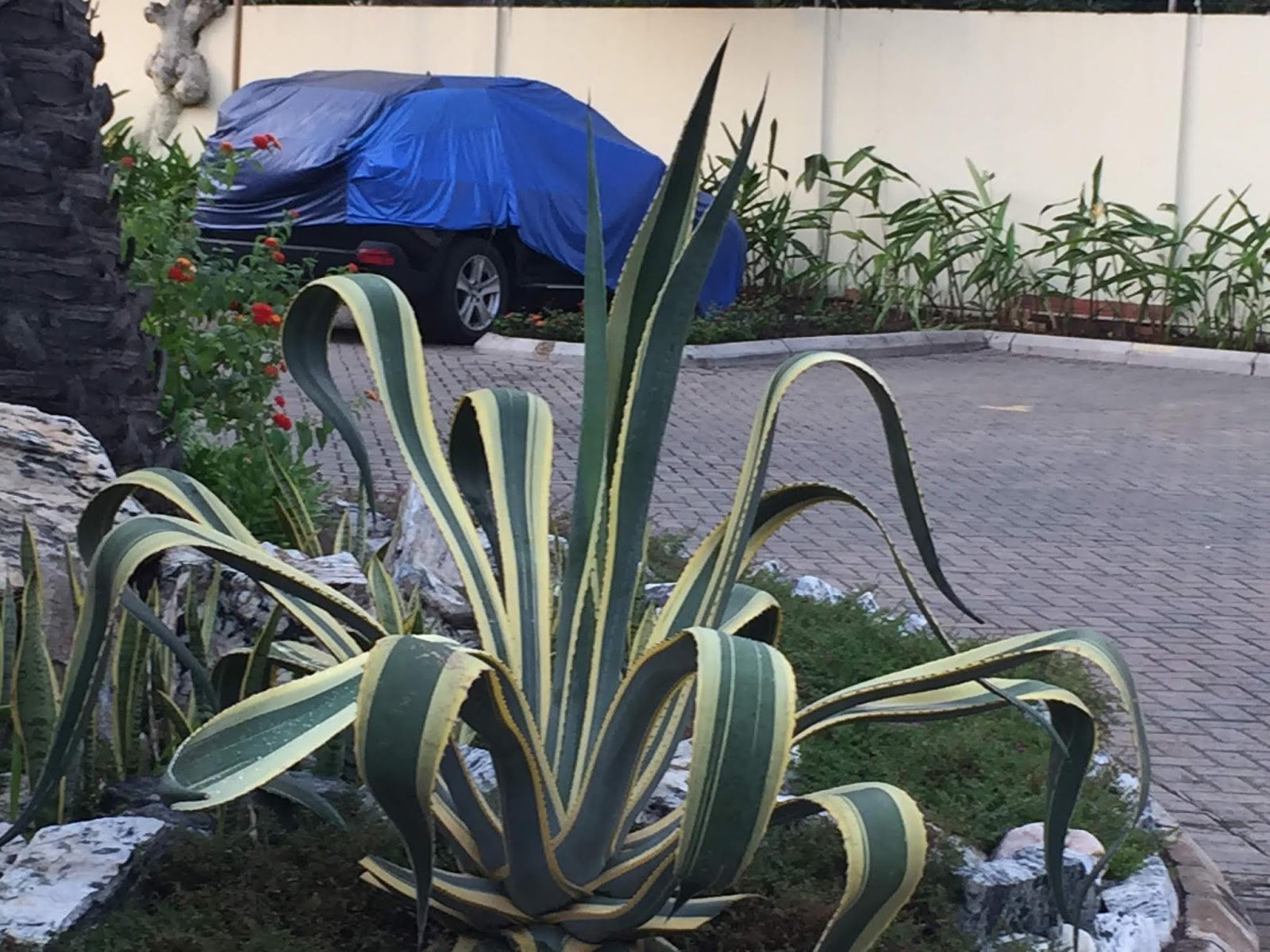
There are other interesting plants, too.

Flowers in the city.

Further examples of blossoms.

The beauty that can be found is excellent.

Sometimes they get right to the point when naming brands here.

Even in the city, goats can be seen grazing all over.  Not all parts of the city have beautiful blossoms.

I mentioned bats in a previous post.  Here are some of them.

Yes, that "fruit" hanging from the top limbs squeaks.  They are bats.

These birds think they rule the country and are not shy, or quiet!

Nor are they intimidated by the presence of a human.

This is a tro-tro.  A cross between a taxi and a bus.  But not in very good mechanical shape.

Ghanaians are a religious people and display it all over, even on tro-tros,

or on auto parts dealers!
Very nice to see these kind of signs rather than some American bumper stickers.

Street hawkers (peddlers) such as these sell wares between vehicles even during heavy traffic.

Don't give up on us.  We get busy at times, but more to come!

Elder Emfield

Thursday, February 14, 2019

Bats, Cockroaches, and Geckos, Oh My!

We have been shown an area in Accra where the trees are filled by thousands of bats!  They simply hang there upside down, and from what we have been told, wait for sundown when they take off en masse.  They love mangoes so there must be some near there, though I did not see any.  One of the missionary couples that have become our good friends report that their "close encounters" are a lot closer than our bat one.  They have 3 to 4 inch cockroaches and geckos in their apartment!  I wonder which is feasting on which.

There are large numbers of beggars at the different intersections around town.  When we stop at the lights they come up to the car looking for help.  Quite a few are suffering from leprosy and will reach out with a hand that is missing all of the fingers beyond the middle joints.  Little children will also approach and make a motion with their hands towards their mouths indicating a need for food.  I do not see people lowering their windows and giving them anything but hope the few who do help them to get through the day.

I am getting pretty good at driving the Ghanaian way.  Lanes and stop signs are considered suggestions.  Stop lights are mandatory unless you are on a bicycle, motorcycle, or you are turning right and no one is coming.  Motorcycles are allowed to drive on the lines between lanes, in the lanes, on the sidewalk, or on the wrong side coming directly at oncoming traffic!  Honking a horn can mean almost anything, but most often means "I'm here" or "I'm coming through so get out of my way!"  Much of the driving is done bumper to bumper - much closer than I ever dared do at home - and people jaywalk everywhere.  At intersections, and far back from them, beggars move between the cars but so do street hawkers selling everything you can imagine: laundry detergent, windshield wipers, tools, fruit, meat pies, Valentine's Day candy, maps, shoes . . . .  Stop lights are extreeeeeemly looooong, probably so the hawkers will have time to sell their wares (which is a good thing because it allows these people to earn a living).  Driving under these conditions poses some interesting challenges and you never want to let your attention wander.  I do not listen to music or anything else in our vehicle.  I drive and nothing else.  One of the things that I have enjoyed about Ghana is how I never see the people arguing.  Well, I did see it once.  We were stopped at a light and there was a very large group of street hawkers who suddenly began to argue among themselves and it went on as long as we were stopped at the light.  To make a long story short, there was apparently a disagreement about who should be selling at this particular intersection.  It appeared to be the old timers against the interlopers.  But there was no violence.  Some loud voices and emphatic gestures, though.  The light changed and I drove away; I wonder who won.

Elder Emfield

Wednesday, February 6, 2019

Beginning of Assignment

While Sister Emfield continues working away at her assignment, something she has been doing since she showed up at the office on the first workday, I now began work with the assignment I was given last week.  Today was mostly orientation for me.  I am to be working with Church education in both an administrative and teaching capacity and was deluged with information on my responsibilities.  It will take quite a while to sort it all out, especially because I do not always understand the explanations I am given.  American English and Ghanaian English have their differences, especially in relation to accent.  One of the leaders with whom I spoke today spoke with a more pronounced accent than most of the people I visit with day to day.  So, I struggled to understand the instructions he gave to me.  I requested that much of the information presented be given to me in writing (There were a couple of PowerPoint presentations used.).  They obliged me, and so far that has been helpful, but I have much more reading to do.  I am excited about making a difference, and hope I do not mess this up.  The Church not only teaches seminary and institute (religious) classes here, but is beginning to supply support for general education, as well.  These things are making a significant difference in the lives of the young people here.

Sister Emfield and I had another Ghanaian meal today.  We are careful where we eat (or even where we buy our food to cook at home).  But we trust the cafeteria in the Area Offices and have quite enjoyed the food there.  Everyone always says how spicy Ghanaian food is, but we just don't find it so.  Too much Mexican, Indian, and Thai food over the years I expect.  We had spiced rice, beans (looked like chick peas), chicken, sort of a beef stew, plantain, and a green leafy vegetable concoction that the cook said was like spinach.  It was quite good, except for the beef.  The only decent beef we have found here is hamburger which we buy in an upscale store and cook at home.  But that's ok.  Ghanaian food doesn't have to be like American for me to like it, though for health reasons I have to be careful about where it comes from.

There are aspects of this mission that are quite amusing.  And it has required somewhat of a mental adjustment.  Consider: back in the U.S. we would fear going out after dark in large areas of Chicago, or in crime ridden areas of other cities.  Here one does not fear that but petting that dog over there, or brushing your teeth with unfiltered water, or being bitten by a mosquito because you went out after dark is terrifying because it can be fatal!  Quite a change in perspective.

Elder Emfield

Sunday, February 3, 2019

Finding the Rhythm of Life - Week 2

We have now been in Accra two weeks.  Last week was much less chaotic and we are starting to feel the rhythm of life here.  We got our truck and Elder Emfield started driving.  I have not been brave enough yet to drive but it takes two sets of eyes to try and stay safe, so I am the official navigator.  We have to be aware of so much going on around us as we drive.  Motorcycles drive wherever they want, and that includes between lanes, darting in and out of cars, sidewalks, both against and with traffic, etc. They do not have to obey traffic rules and can run stoplights, etc.  They constantly honk so you know they are there.  Tro tros are their public transportation.  They are little vans (usually in very poor condition)  that have a yellow line painted around the lower sides.  They pack them with people and get paid by how many people they carry.  Therefore, nothing is more important to them than being able to get to more people to transport.  They will do whatever it takes to do that.  That means they do not follow any traffic rules and will force their way in between you and the next car and you had better move.  Traffic is very heavy.  Bicycles are also common. At the lights, which are very long, people come into the streets selling everything you can imagine. We have seen all sorts of food, belts, jump ropes, windshield wipers (which they install on site), yoga pants, CDs, toilet paper, watches, car mats, etc.  If they can carry it, you can find it on the street.  There are also a lot of people begging and many are blind or crippled, sometimes sitting on little scooter boards low on the ground.  It is very hard to see everything and make sure you don't injure them, yourself or your vehicle.  We are glad we have a truck so we are sitting up higher and are more able to see.  I will post pictures of this as soon as I can take some.  Right now, I don't dare take my eyes off the road to help watch for anything we could run into.

I am finding that my calls involve both mental and physical health so consult often with the AMA (Area Medical Adviser).  Often medical issues are emotionally driven, but I am also finding that with a lot of the Africans, the mental health is often driven by an underlying untreated physical problem.  So many of our missionaries are in countries out in the bush and away from any contact with medical help, so we call the Mission Presidents and get them into the Mission Home and whatever interventions are needed.  Liberia and Sierra Leone are especially that way.  We all rely on each other to stay in contact with them and pull together as a team to keep them safe.  Of course, without the Spirit, we would often miss these problems, especially when dealing by phone.

Elder Emfield got his assignment on Friday.  He will be working on a counsel with the Global Education Initiative.  What exactly that entails is yet to be seen. He will learn more this week.  The Church is trying to make education more easily accessible to everyone. However, they have found that building schools and taking children to them is not the best way. They are trying to keep the children home with their families and bring education to them.  Ghana is a pilot program for this.  Many of the children here leave home and go to boarding school to get an education.  Most of the education is learning by rote, not critical thinking which puts the children at a disadvantage if they don't learn those skills.  It also separates them from their families.  The Church is growing here, but most of the missionaries from this area come from those who are baptized when they are in their late teens, early twenties.  The children who are "raised in the church" really haven't been in much contact with the Church or their families much, so they fall away and lack understanding of the teachings.  Their families have very little influence in their lives.  Hopefully, this will help families educate their children and help the children develop good thinking and leadership skills. Local people are in charge of the program here, but in counsel with others, so it will still meet the needs of the local people and not be a "we outsiders know best" kind of program.

We lost power for about 24 hours this past week.  That meant no lights, no air conditioning, no internet, no hot water and no filtered water.  We have to filter our water or drink bottled water here.  The regular water is so unsanitary we cannot even brush our teeth with it.  We are told not to even keep the toothbrush where regular water can splash on it or we could get very sick.  The power goes out a lot here.  One of the elders told me there is a Chi word for power outage - dumos. This means off/on because that happens so much.  When I went to church in the Anyaa ward last week, the power was off for the first 30 minutes.  It was nice when then fans came back on to move the air.

We went to church in the Cantonments Ward today because we haven't been assigned a ward here yet.  It's much like things in the States.  When it came time for testimonies, the members were reminded to bear a testimony, not tell stories etc. and that there were other platforms where those stories could be shared.  The members rush to the stand and there isn't a pause until the time to end. Their testimonies are very basic and pure.  It is wonderful!  One difference we noted was that while we attended in the US, we rarely saw General Authorities.  Today we attended with two General Authority Seventies and two Area Authority Seventies.  It has been so nice to get to know them and see that they are real people, just like the rest of us.  Elder Nash is the Area President and we have enjoyed getting to know him.  He and Elder Emfield have really hit it off talking history.  Elder Martinez is the person I report to.  His wife is very sweet and offered to take me to Market (sort of like a big craft fair) with her when it comes next month because I couldn't remember how to get there yesterday. We have met  Elder Dube and have a meeting with him on Thursday.  We are working together with LDS Family Services to coordinate Mental Health Resources and establish a hotline that can be reached 24/7 to help people contact mental health services.  There is no line or status here between callings in the Church.  We are all just here trying to bring people to Christ and each have our own role in it.

The people here are very easy to love.  They are very friendly and welcoming.  When they find you are new here, they always say "You are welcome."  It is a greeting often used for newcomers.

We are loving our time here and are looking forward to growing and learning from the opportunities and people we are surrounded with.

Sister Emfield

 For those of you that have been following us, our blogs halted in March.  By way of explanation, this was because of Covid-19.  The appeara...